Russia is invisible army

by Emil Lengyel
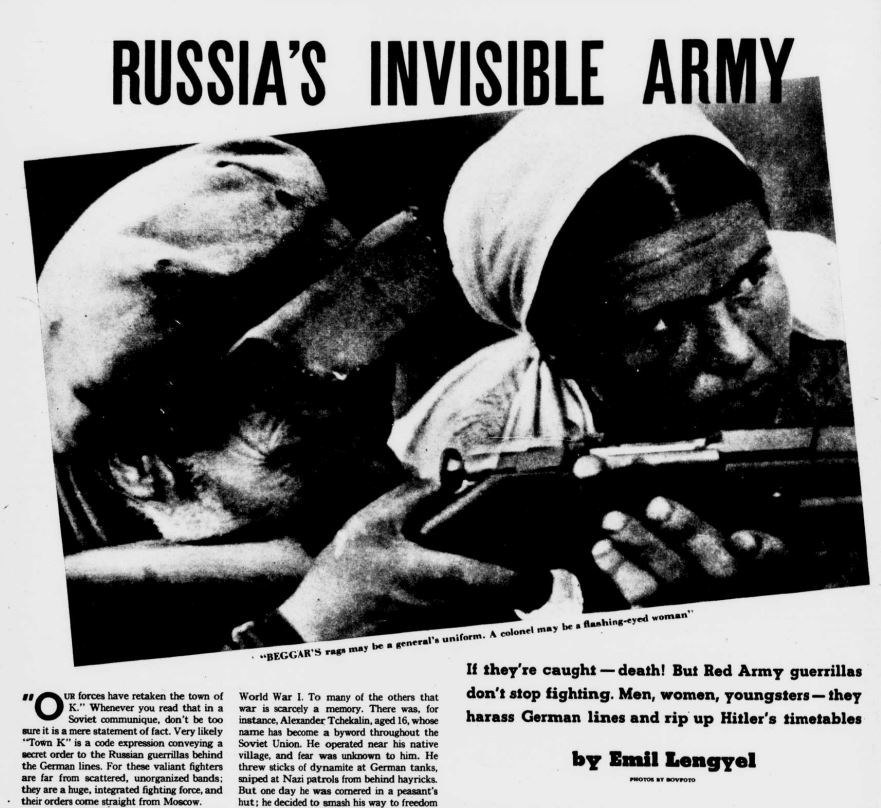
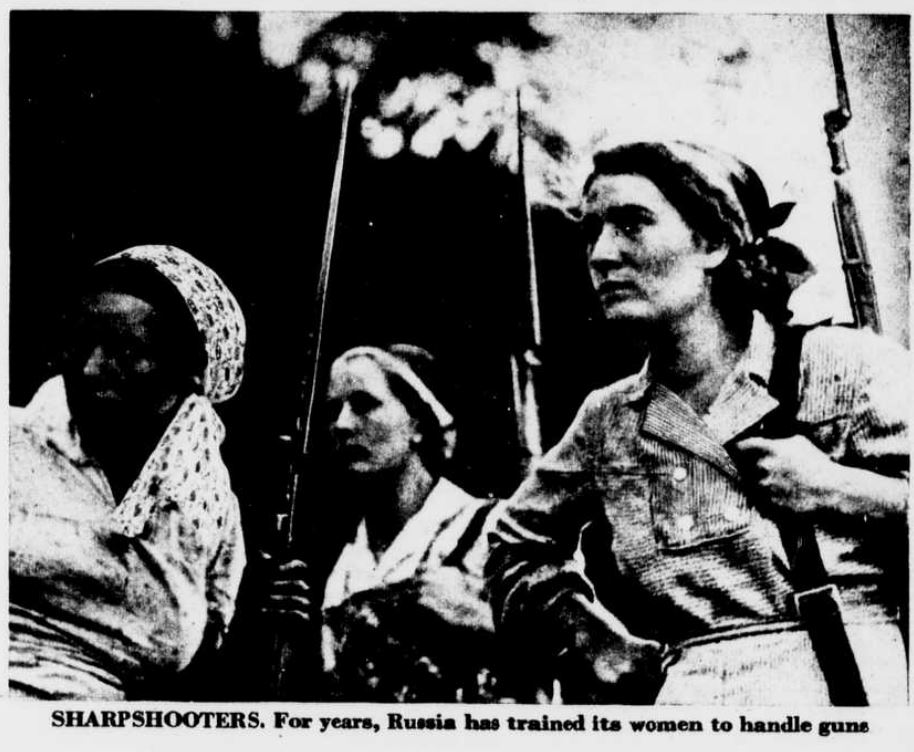
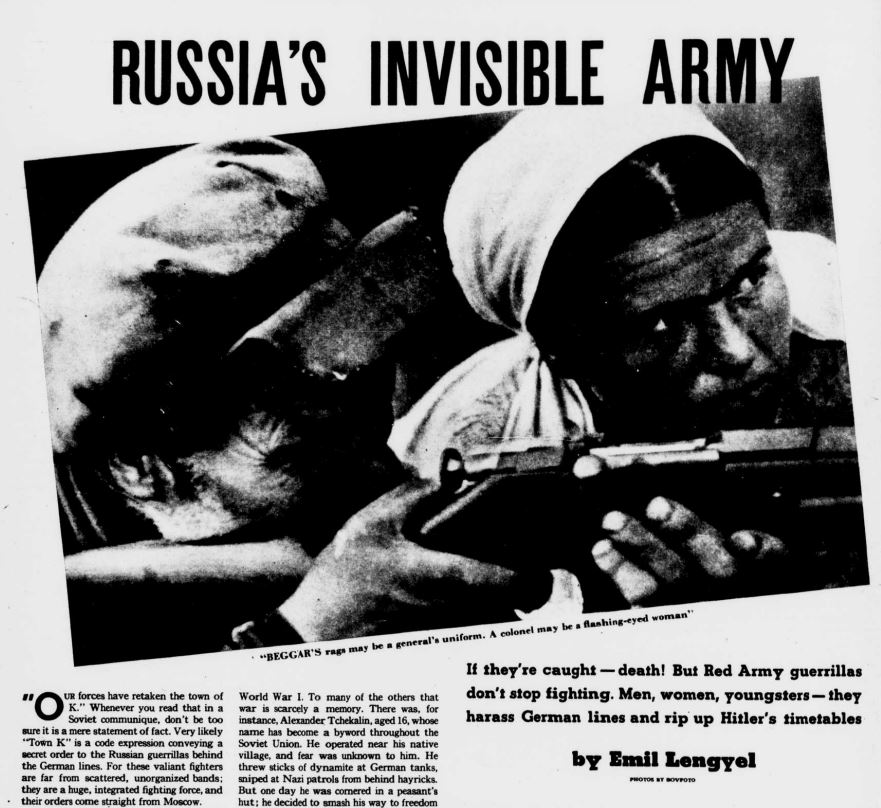
" Our forces have retaken the town of K ". Whenever you read that in a Soviet communique, dont be too sure it is a mere statement of fact. Very likely "Town K" is a code expression conveying a secret order to the Russian guerrillas behind the German lines. For these valiant fighters are far from scattered, unorganized bands; they are a huge, integrated fighting force, and their orders come straight from Moscow. Never in history have guerrillas played such an important part as they do in Russia today. They form an underground front behind the front, and are everywhere and nowhere. They are more dangerous than flame throwers and dive bombers because no sound betrays their lightning approach. They cover every inch of the hinterland, and as quick as they come, they disappear in the forest mist. They are at least as much responsible for German reverses this winter as the stinging cold of the steppes and the death-defying gallantry of the Soviet soldiers. They are known as the ? partisans,? and Russia is full of their praise. There may be millions of them, operating in large formations as well as in small units. What kind of people are these partisans? Gray-haired mujiks rub shoulders with boys and girls in their teens. Fathers and sons, mothers and daughters are fighting side by side. Some of the old-timers are veterans of World War I. To many of the others that war is scarcely a memory. There was, for instance, Alexander Tchekalin, aged 16, whose name has become a byword throughout the Soviet Union. He operated near his native village, and fear was unknown to him. He threw sticks of dynamite at German tanks, sniped at Nazi patrols from behind hayricks. But one day he was cornered in a peasants hut: he decided to smash his way to freedom or to sell his life dearly. With a grenade in his hand, he met the Nazis halfway. The hand grenade turned out to be a dud; the Germans hanged the boy. The Soviet government decorated him posthumously with the highly-coveted Order of Lenin, and the title of ? Hero of the Soviet Union,? the nations greatest honors. Some of the partisan commanders are regular-army officers, while others are just plain village folk. "Division X of the Red Army has been destroyed,? the German high command would announce. But Division X was destroyed only as a visible unit; it would turn up behind the lines as a sector of the great invisible army, commanded by its own officers. Beggars rags may be a generals uniform among the partisans, and a colonel may be a flashing-eyed woman. Common peasant commanders sometimes reveal remarkable gifts of ingenuity and organization. The partisans have their nameless Napoleons. The Soviets have long been preparing for just this type of warfare. Not fewer than 40,000,000 of their citizens have been trained as partisans, we are told. "Proletarian Rifle Divisions? are regular features of Moscow Red Square parades. Thousands of their civilian members march in company formations, armed with rifles. The technique of guerrilla warfare, how to read maps, how to find ones way by compass, are being taught by the organization known as "Osoaviachim, " with millions of members. For years young Russia has been learning parachute jumping, has been toughened up by all kinds of mass sports. Even women and children have been taught to handle rifles. "Every bush, every peasant house shoots at you," German soldiers complain. "The entire civilian population of the occupied territories has risen, " a German-controlled Belgian newspaper wailed the other day. "The Bolsheviks do not observe lawful methods of warfare.? Front-line Red soldiers often notice that the enemys fire is suddenly reversed, scouring the rear. Then they know that partisan fighters are at work behind the Nazi lines. The guerrillas seek to shear off German supply lines, cut tank units from their fuel base. Isolated from the rear, the Germans must turn their tanks into forts and shoot it out until their ammunition is exhausted or reinforcements arrive. The partisans dig traps for the enemys mechanized forces, destroy bridges, tunnels, viaducts, railway tracks, set fire to oil and food stores, ammunition dumps, flour mills. They snipe at occupation garrisons, at reserves moving up to the front, at retreating formations. They decoy entire regiments into swampy wasteland, and then destroy vital military objectives in their absence. Small groups of partisans sneak up toGerman field headquarters, slaughter their staffs. A typical case of partisan work was that of ? Commander O,? chairman of a local Soviet, who captured the railway station ? G.? In less than half an hour his men destroyed miles of telephone and telegraph wires, railroad tracks, the water pump, then set the station on fire. When the Russian army was retreating last year, it was the partisans who completed its scorched-earth policy. They saw to it, too, that their countrymens morale in the occupied land should not sag. They are largely responsible for the fact that no Quislings have been found by the Germans, for they maintain an underground government, punish treason and execute the Soviet law while the regular government is absent. Recently the partisans have devised new ways to render the enemys life unbearable. They are flooding the Nazis line of retreat, turning it into a sheet of ice, paralyzing the machines of war. They are littering the highways with multi-pointed iron barnacles that pierce the tires. They construct fake artillery positions in the rear to keep the retreating Nazis worrying and guessing. The partisans have their own special war machines, which they call the ? tatchanka.? They may be tractors or combines (harvesters and threshers), the number of which is legion in the Soviet Union. The weapons mounted on them are of a wide range. Rifles of Crimean War vintage are no rarity, but they also have flame throwers and planes. Many of the partisan forces are in constant touch with one another, as well as with units of the regular army. This is rendered possible because the Russian line is not continuous. Messengers are sometimes disguised as peasant women, carrying water from the well. Radio transmission is also employed on a large scale. The Russian high command had a large section of the western country wired for underground telephone before the war, preparing for such a contingency. Noncombatant peasants are also serving the partisans. The vast behind-the-lines operations could not be successful without thenactive help. They transmit prearranged signals to the fighters; their women cook and do the laundry of the partisans. The guerrillas also have their secret newspapers in the occupied country, such as the celebrated "Stalinist Post,? which not merely spreads news but also builds up morale and passes on orders. Honored Citations for partisan work are very frequent in Russian military bulletins. The Order of Lenin and the title Hero of the Soviet Union have been conferred on many of them. Not fewer than a million Germans are fighting the partisans behind the lines, the Russians say. The punishment of the guerrillas is hanging. ? You are hereby ordered,? the commander of the 123rd German Infantry Division, Major General Rauch, instructed his subordinates recently, "to leave the executed guerrillas hanging for a certain time in public squares.? It is only seldom that a partisan captured by the Germans lives to tell the story of his exploits. But this is what happened to a young partisan whom newspapermen recently found in the zone reoccupied by the Red Army. When the Nazis captured him, they told him to walk away from them. Five steps away they shot at him, and the bullet passed through his neck and out of the mouth. He fell down, wounded, and pretended to be dead. The Germans piled snow on him, shot a bullet into the mound to be sure that he was dead. This bullet only grazed his right hand. After a while he got up, took refuge in a friendly village, until Red soldiers drove the Nazis back. The Germans scour the guerrilla countryside in reconnaissance planes, followed by bombers. They set fire to woods sheltering partisan forces. They bum villages and execute hostages. Even 90, wise commanders have found it safer to take long detours around forests and to patronize well-protected highways. Partisan warfare is fully in line with Russian traditions. It was the partisans who turned Napoleons retreat from Moscow into a rout. As long as half a century ago, Lenin himself advocated the formation of such units in the Czarist army to spread confusion in its ranks. Partisans did some very effective work behind the lines in the Russian Revolution of 1905, which followed the disastrous RussoJapanese War. When the Communists became a strong force they formed their own militia, a secret military organization. The collapse of the Czars armies during the First World War was in no small measure caused by deserters who turned guerrilla against their own forces. Early Bad Partisans The partisans great day came with the end of World War 1. Enemies closed in on all sides. The Bolshevik government was fighting for its very life. Several armies converged upon Leningrad and Moscow, led by counterrevolutionary leaders, the "Whites.? In an effort to combat bolshevism, foreign countries despatched expeditionary forces to Russia. Time was short and it would have taken long to set up a regular army. The Soviet leaders appealed to the peasants to prevent the return of the old order, and they organized guerrillas. Some of the partisan leaders have become legendary figures. The Soviet leaders have never forgotten the lesson of the Civil War. They have put the theory of partisan warfare to practical tests on different occasions. They trained Spanish loyalists in the art of partisan warfare. Even greater success attended their work in China, where they helped to train the famous Eighth Route Army in partisan methods. Chinese partisans have been working for years behind the Japanese lines. As soon as the Germans launched their attack on the Soviet Union last June, the partisans got down to work. Less than a fortnight later the Nazis were well on the way to Leningrad and Moscow, and nothing seemed to be able to halt the formidable juggernaut. It was on July 3 that Joseph Stalin appealed to the partisans to launch an all-out counterattack and help save the Soviet Union. At that time this was thought by many outside observers an admission of weakness and perhaps even of impending doom. In reality, Stalin was merely calling upon the vast reserves of civilian strength the Soviets had been accumulating for just such an emergency. The response of the people surpassed the most optimistic expectations. Instead of turning against their government, as the Germans had expected, the inhabitants of the occupied regions rose as one man against the invaders. ? You cannot hang us all,? young partisan Alexander Tchekalin, whose name has already been mentioned, told his hangmen under the gallows. ? There are too many of us; we will win.? The words may be apocryphal. Just the same, they have been inscribed ii? the history books of partisan warfare. The Germans failed to reach Leningrad, Moscow and Sevastopol, and for their failure the partisans deserve much of the credit. The part they have played, living in the shadow of the gallows, is a great epic of the Russo-German War. The End
Evening star