America Faces New Crises in Far East and Atlantic; Nazi Armies Imperil Moscow
by Oliver McKee
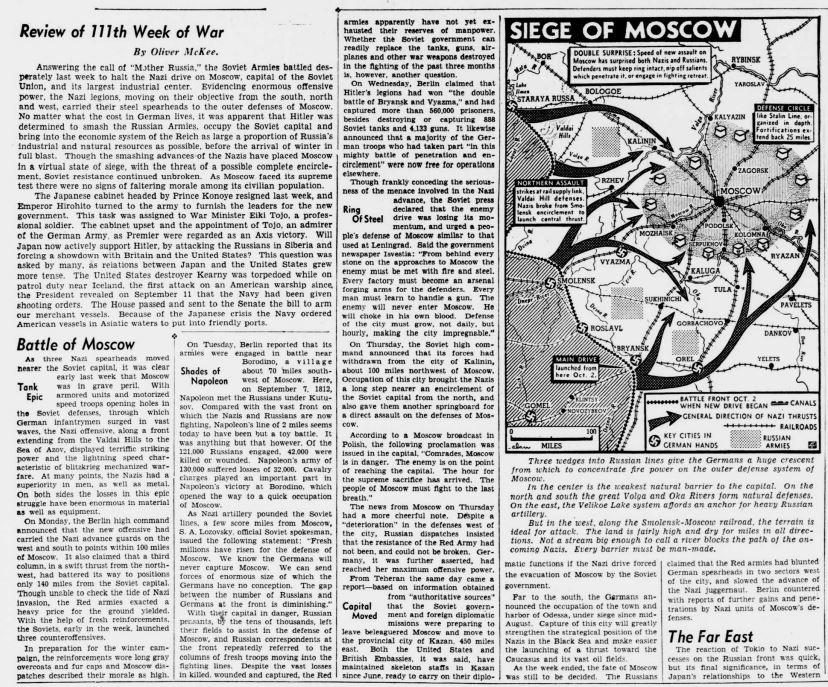
Answering the call of Mother Russia, the Soviet Armies battled desperately last week to halt the Nazi drive on Moscow, capital of the Soviet Union, and its largest industrial center. Evidencing enormous offensive power, the Nazi legions, moving on their objective from the south, north and west, carried their steel spearheads to the outer defenses of Moscow. No matter what the cost in German lives, it was apparent that Hitler was determined to smash the Russian Armies, occupy the Soviet capital and bring into the economic system of the Reich as large a proportion of Russias industrial and natural resources as possible, before the arrival of winter in full blast. Though the smashing advances of the Nazis have placed Moscow in a virtual state of siege, with the threat of a possible complete encirclement, Soviet resistance continued unbroken. As Moscow faced its supreme test there were no signs of faltering morale among its civilian population. The Japanese cabinet headed by Prince Konoye resigned last week, and Emperor Hirohito turned to the army to furnish the leaders for the new government. This task was assigned to War Minister Eiki Tojo, a professional soldier. The cabinet upset and the appointment of Tojo, an admirer of the German Army, as Premier were regarded as an Axis victory. Will Japan now actively support Hitler, by attacking the Russians in Siberia and forcing a showdown with Britain and the United States? This question was asked by many, as relations between Japan and the United States grew more tense. The United States destroyer Kearny was torpedoed while on patrol duty near Iceland, the first attack on an American warship since, the President revealed on September 11 that the Navy had been given shooting orders. The House passed and sent to the Senate the bill to arm our merchant vessels. Because of the Japanese crisis the Navy ordered American vessels in Asiatic waters to put into friendly ports. Battle of Moscow As three Nazi spearheads moved nearer the Soviet capital, it was clear early last week that Moscow Tank was in grave peril. With gpjc armored units and motorized speed troops opening holes in the Soviet defenses, through which German infantrymen surged in vast waves, the Nazi offensive, along a front extending from the Valdai Hills to the Sea of Azov, displayed terriffic striking power and the lightning speed characteristic of blitzkrieg mechanized warfare. At many points, the Nazis had a superiority in men, as well as metal. On both sides the losses in this epic struggle have been enormous in material as well as equipment. On Monday, the Berlin high command announced that the new offensive had carried the Nazi advance guards on the west and south to points within 100 miles of Moscow7. It also claimed that a third column, in a swift thrust from the northwest, had battered its way to positions only 140 miles from the Soviet capital. Though unable to check the tide of Nazi invasion, the Red armies exacted a heavy price for the ground yielded. With the help of fresh reinforcements, the Soviets, early in the week, launched three counteroffensives. In preparation for the winter campaign, the reinforcements wore long gray overcoats and fur caps and Moscow dispatches described their morale as high. On Tuesday, Berlin reported that its armies were engaged in battle near Borodino, a village Shades of about 70 miles south Napoleon west of Moscow. Here, on September 7, 1812, Napoleon met the Russians under Kutusov. Compared with the vast front on which the Nazis and Russians are now fighting, Napoleons line of 2 miles seems today to have been but a toy battle. It was anything but that however. Of the 121.000 Russians engaged, 42.000 were killed or wounded. Napoleons army of 130.000 suffered losses of 32,000. Cavalry charges played an important part in Napoleons victory at Borodino, which opened the way to a quick occupation of Moscow. As Nazi artillery pounded the Soviet lines, a few score miles from Moscow, S. A. Lozovsky, official Soviet spokesman, issued the following statement: Fresh millions have risen for the defense of Moscow. We know the Germans will never capture Moscow. We can send forces of enormous size of which the Germans have no conception. The gap between the number of Russians and Germans at the front is diminishing. With their capital in danger, Russian peasants, by the tens of thousands, left their fields to assist in the defense of Moscow, and Russian correspondents at the front repeatedly referred to the columns of fresh troops moving into the fighting lines. Despite the vast losses in killed, wounded and captured, the Red - armies apparently hava not yet exhausted their reserves of manpower. Whether the Soviet government can readily replace the tanks, guns, airplanes and other war weapons destroyed In the fighting of the past three months is, however, another question. On Wednesday, Berlin claimed that Hitlers legions had won the double battle of Bryansk and Vyaz
Evening star